




Not all matcha is grown to be experienced in the same way. Although matcha may appear to be a single-category product, its quality can vary substantially based on how the tea is cultivated, harvested, processed, and stored. Factors such as shading techniques, harvest timing, leaf selection, cultivar, and milling methods all influence the balanced taste profile of the final product.
Producing the finest ceremonial grade matcha requires extraordinary attention to detail and patience. The youngest leaves must be carefully selected, stems meticulously removed, and the leaves stone-ground into an ultra-fine powder. Even the type of mill and speed of the milling matter here.
The most important thing to understand is that Japan does not maintain an official grading system for matcha. Terms such as ‘ceremonial grade’ and ‘culinary grade’ are not technically regulated classifications. Rather, they are consumer-facing categories that originated outside of Japan. Think of them as marketing terms to help consumers distinguish between matcha intended for direct drinking and matcha intended for cooking. But while these terms can be useful, they are not guarantees of quality, and the distinction between them is often less clear than it appears.
This makes it especially important to understand what actually contributes to exceptional matcha.
What is Ceremonial Grade Matcha vs Culinary Grade Matcha
To make things easier, we’re defining ceremonial matcha powder as the highest-grade form of matcha. While not a technical definition, it’s the term we use for matcha intended to be enjoyed in its purest form, whisked with water and consumed as is. The term ‘ceremonial’ draws from the traditional Japanese tea ceremony, where the quality of the powder is of absolute importance.
To achieve this standard, producers typically cultivate their tea trees in the shade before selecting the youngest leaves from the first spring harvest. The stems are then carefully removed from each leaf, and the remaining leaf is stone-ground into an exceptionally fine powder. The result, found at Ceremony, is a vibrant, smooth, and naturally sweet matcha with minimal bitterness.
Often referred to as a lower-quality blend, culinary grade matcha serves a different purpose. Rather than being evaluated for its pure drinking experience, it is formulated to maintain its flavour when combined with milk, sweeteners, and baking ingredients. While more affordable than ceremonial grade matcha, the price reflects the differences in the production process. Depending on the cultivar, a culinary grade matcha may omit one or more of these important steps; for instance, it may be harvested from the second or third flush, processed with a mechanical mill, or not stripped of all its stems. The flavour profile that we are left with performs well when masked with other ingredients, but is usually more bitter when consumed on its own.
Both grades have their place.
Why Ceremonial Grade Matters for Energy and Wellness
The cultivation practices used to produce premium ceremonial matcha powder influence not only its flavour profile but also its nutritional contents. When a tea tree is planted, the nutrients from the soil are directed towards its newest sprouted leaves throughout the winter months. These young leaves, which are essential to the matcha harvest process, naturally contain higher concentrations of theanine, antioxidants, chlorophyll, catechins, and other beneficial plant compounds.
Particularly noticeable is L-theanine, a unique amino acid found almost exclusively in tea plants, which accumulates at higher concentrations when the plant is grown and harvested in the shade. We like to think of L-theanine as matcha's most powerful compound. L-theanine and caffeine are believed to work together to provide a slow-release energy boost that promotes a state of calm alertness, without the spikes and crashes often associated with other caffeinated drinks.
Matcha is also rich in antioxidants, including epigallocatechin gallate (EGCG), one of the most extensively studied catechins in green tea. While research is still ongoing, EGCG is known for its role in supporting heart health and cellular protection from free radicals.
The shading process that contributes to elevated L-theanine levels has another benefit. It also increases the chlorophyll production, a factor that gives ceremonial matcha powder its characteristic vibrant green colour. Chlorophyll is a naturally occurring plant pigment that is said to offer its own set of health benefits, including support for liver detoxification. The greener the matcha, the higher the chlorophyll content, the higher the quality.
Because matcha is consumed as whole leaves rather than steeped and discarded like regular tea leaves, it is also rich in vitamins and minerals known to support brain and cognitive function, heart and liver health, and immune health, all while providing balanced energy and improving mood.
The tea plant can be harvested as culinary grade matcha a few more times throughout the year. This is why the first harvest produces the higher-quality, more expensive teas. Matcha served at the Ceremony Matcha Bar and stocked on our website is always ceremonial grade.
How to Identify High-Quality Ceremonial Matcha Powder
Colour: The Visual Indicator
Colour is often the first indication of a matcha powder's quality.
Well-shaded, carefully processed and milled leaves typically produce a vibrant green powder thanks to the high levels of chlorophyll, while lower-grade powders often appear duller, olive-toned, or even yellowish. The colour differences point towards the variations in shading practices, harvest timing, and leaf selection. Factors such as harvesting older leaves and not properly removing the stems will also affect the colour of the finished product.
That said, colour alone should never be used as the sole measure of quality, as different cultivars can naturally produce different shades of green. After all, tea leaves are a natural product, and some high-grade matcha cultivars will simply appear brighter than others.
Texture: The Sign of Careful Milling
Premium ceremonial matcha powder should have an ultra-fine, almost silky texture. The top quality powders are always ground by stone. When tested in a laboratory, each grain should be between five and ten microns in diameter. This fine particle size allows the powder to disperse more evenly throughout the water, creating a smoother mouthfeel and a more refined drinking experience.
Matcha powder that is not ground properly will typically be coarser in texture. For example, culinary grade matcha grains settle quickly in the water, often creating small clumps when made into a beverage.
This is the reason Ceremony’s matcha doesn't require sifting before whisking. The product is already so finely ground that it is not meant to clump when mixed with water, creating a velvety-smooth drinking texture.
Foam: An Indication of the Preparation Process
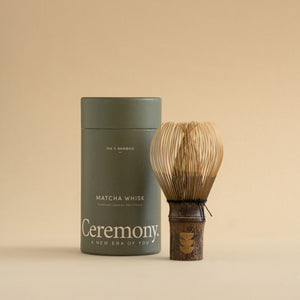
When whisked correctly with a traditional bamboo whisk, ceremonial matcha powder typically develops a dense layer of fine microfoam across its surface. This is caused by the amino acid content in the powder. The higher the quality of matcha, the higher the amino acid content.
The foam isn’t just a great indicator of matcha quality; it also serves a practical purpose for the drink's taste by aerating the liquid, giving it a smoother, more balanced profile and an enhanced aroma. If whisked correctly, this matcha-and-water blend should be sweet and flavourful enough to drink on its own, without added mylks.
On the other end of the spectrum, whisking low-quality matcha can create a bubbly effect without producing the firm layer of foam we are looking for.
Ceremony’s Approach to Ceremonial Grade Matcha
At Ceremony, we source organic, first-harvest matcha from our supplier in Kagoshima, one of Japan’s most respected tea-growing regions. Kagoshima’s rich volcanic soil, warm climate, and abundant rainfall create the ideal conditions for producing matcha with exceptional sweetness, depth, and colour. Never bitter. Only smooth.
Our ceremonial matcha powder is produced from carefully selected young leaves that are shade-grown and stone-ground to preserve the flavour and fine texture that allows us to prepare our matcha without using a sieve.
Importantly, we evaluate our matcha according to the standards used by experienced Japanese tea producers and tea masters, rather than relying solely on Western marketing terminology. While ‘ceremonial grade’ remains an unregulated category, our sourcing prioritises the characteristics most commonly associated with exceptional matcha: first-harvest leaves, careful cultivation, vibrant colour, fine texture, natural sweetness, and a sustained energy release. Once the product reaches the shelf in Cape Town, we keep our matcha airtight in the freezer to keep it from oxidising too quickly.
The result is a matcha powder smooth enough for Japanese tea masters to serve. It is the purest form of matcha, made to be enjoyed without mylk, sweeteners, or other flavours masking it.
This is the standard we believe ceremonial grade matcha should meet.

